
🔍 Quick Summary
- The Main Takeaway: The “one or the other” debate is often a false dichotomy; 2026 guidelines push for organ protection over just lowering blood sugar, often meaning both drugs are necessary.
- Who Needs to Care: Anyone newly diagnosed with Type 2 Diabetes (T2DM) facing the “Fail-First” insurance gauntlet.
- Why It’s Trending Now: With the 2025 ADA Standards shifting focus to weight and heart health, the “old school” Metformin-only approach is officially outdated for high-risk patients.
The 2026 Metabolic Dilemma
Let’s be real: getting diagnosed with Type 2 Diabetes in 2026 feels less like a medical event and more like entering a high-stakes negotiation. Ten years ago, the path was linear. You got the diagnosis, you cut out soda, and you took your Metformin. Simple.
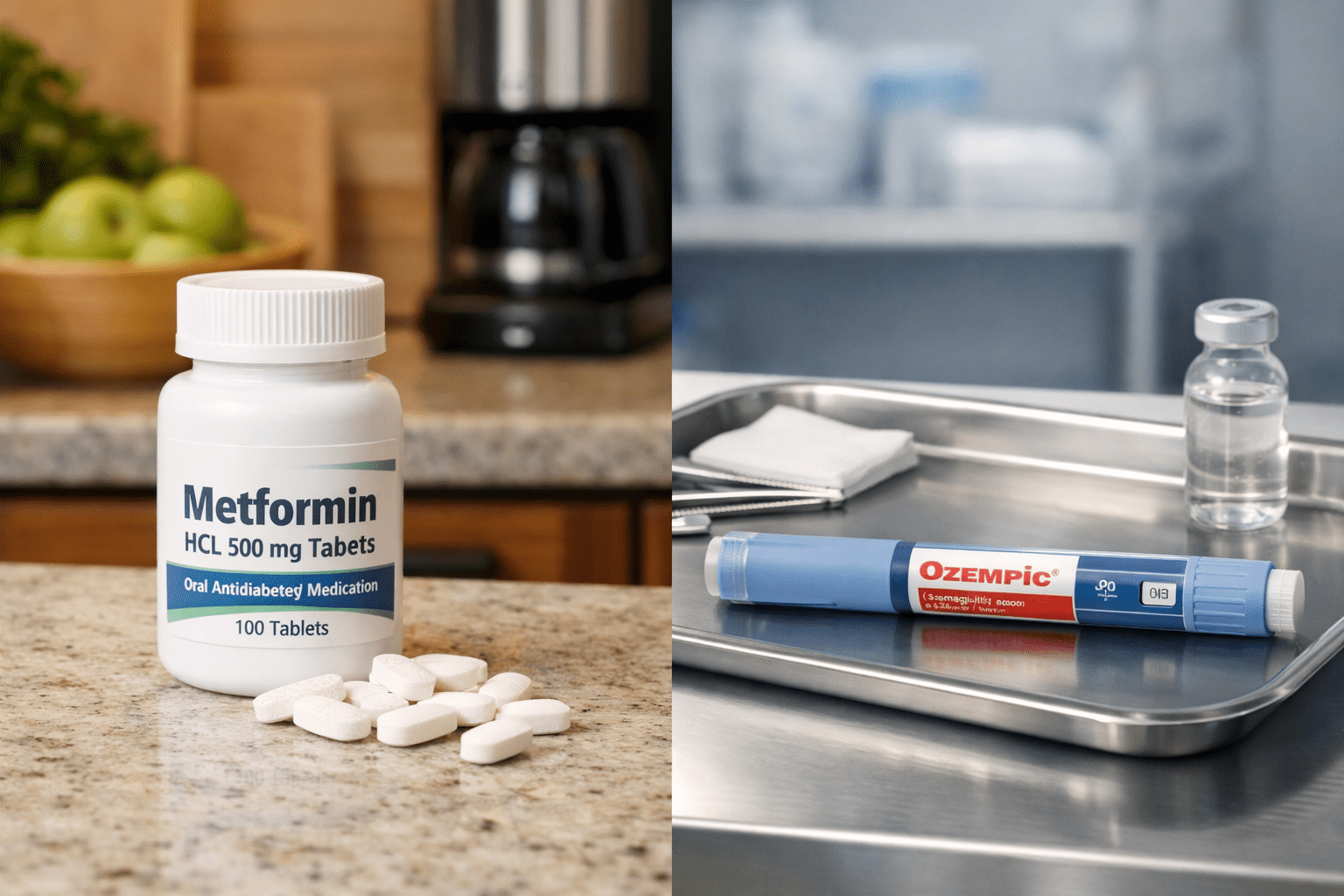
Today? It’s a jungle. You aren’t just handed a prescription; you’re thrust into a culture war between “old reliable” generics and the viral, injectable celebrities of the pharmaceutical world. Right out of the gate, patients are forced to weigh Ozempic vs Metformin—a decision loaded with financial cliffs, biological trade-offs, and a surprising amount of social pressure.
Here’s the kicker: The 2025 American Diabetes Association (ADA) Standards of Care completely shifted the goalposts. We used to care only about sugar (glucose). Now? The goal is “cardiorenal protection.” If you have heart or kidney risks, doctors are essentially told to bypass the old rules and get you on the heavy hitters immediately. But does that mean Metformin is dead? Absolutely not.

Beginner Panic: Needles vs. Horse Pills
The first hurdle isn’t chemical; it’s psychological. When you look at the mechanics of these two drugs, you are choosing between two very different burdens.
The “Needle Phobia” is Mostly Hype
If you’re terrified of the Ozempic pen, take a breath. The “needle” is a 32-gauge engineering marvel—roughly twice the thickness of a human hair. Unlike the lancets you use to prick your finger (which smash into sensitive nerve endings), this 4mm tip goes into fatty tissue that barely feels a thing. It’s mostly anticipatory anxiety.
The Metformin “Pill Burden”
Metformin, on the other hand, asks for grit. The pills are often large (“horse pills” is the technical term among patients), and you have to take them daily, sometimes twice a day. It requires executive function—remembering to take it with meals every single time—whereas Ozempic is a “set it and forget it” once-weekly affair.
The Side Effect Showdown
This is where the rubber meets the road. Both drugs levy a tax on your gut, but they attack from opposite ends.
Metformin: The Lower GI Storm
If you start Metformin, you need to know about the “VOSS Water” phenomenon. Because the drug changes how your gut handles bile acids, it can lead to urgent, watery diarrhea. (It’s not glamorous, but we promised real talk).
- The Stats: About 53% of users get the runs.
- The Fix: Always ask for the “Extended Release” (ER) version. It’s the difference between a bad week and a bad year.
Ozempic: The Upper GI Stasis
Ozempic doesn’t make you go; it stops you up. By delaying gastric emptying, it keeps food in your stomach for hours. This signals “fullness” to your brain, but if you eat a greasy burger, that food just sits there. The result? Nausea (20% of users) and the dreaded sulfur burps.
Note: There is a lot of noise about “stomach paralysis” (gastroparesis). While the FDA did add a warning for ileus in late 2023, true pathologic paralysis is rare. For most, the slowing is exactly how the drug works.
Long-Term Risks: The Hidden Costs
Beyond the bathroom habits, there are silent changes happening inside your body that you won’t feel until it’s too late.
The Muscle Trap (Sarcopenia)
This is the dark side of the Ozempic miracle. In major trials like STEP-1, nearly 40% of the weight participants lost wasn’t fat—it was lean mass (muscle and bone). If you are older, this is dangerous. You might end up “skinny fat” (sarcopenic obesity), where you look thinner but have the metabolism of a much older person.
- The Fix: You must lift weights and eat high protein (1.2g/kg). It’s non-negotiable.
The Vitamin Drain
Metformin plays the long game. Over 5+ years, it can block your absorption of Vitamin B12. The scary part? The symptoms of low B12 (tingling toes, numbness) look exactly like diabetic neuropathy. Don’t let your doctor confuse the two. Ask for a B12 test every year.
For more on dietary impacts, check out our deep dive on itching after eating sugar.
The Insurance Gauntlet
In the US, the “best” drug is often just the one your insurance covers.
The “Fail-First” Reality
Insurance companies (PBMs) love Metformin because it costs pennies (NIH). They hate Ozempic because it costs ~$1,000 a month. To get the good stuff, you usually have to undergo “Step Therapy.” You must take Metformin for 90 days and “fail” (meaning your A1c didn’t drop enough or you couldn’t tolerate the side effects).
- Pro Tip: If you have established heart disease, your doctor can sometimes bypass this step using the 2025 ADA guidelines as leverage.
The 2026 Pricing Cliff
Novo Nordisk’s 2026 pricing strategy includes a nasty trap: an “Intro Offer” of ~$199/month that jumps to ~$349 after eight weeks. If your insurance doesn’t kick in by month three, you’re left holding a very expensive bill.
The Verdict: It’s Not a Cage Match
At the end of the day, the Ozempic vs Metformin debate is a false choice. For most patients, the answer is “both.” Metformin acts as the foundation—it’s cheap, safe, and might even help you live longer (thanks to the TAME trial data). Ozempic is the heavy artillery for weight and heart protection. Don’t fear the combination. Often, using Metformin allows you to stay on a lower, more tolerable dose of Ozempic, giving you the best of both worlds without the nausea or the bankruptcy.
FAQ
1. Can I take Metformin and Ozempic together?
Absolutely. In fact, it’s often the “Gold Standard” treatment. They work on different parts of your body (liver vs. brain/pancreas), so they attack diabetes from two angles. Plus, the combination often leads to better weight loss than either drug alone.
2. Which one is safer for my kidneys?
Historically, doctors worried about Metformin and kidneys, but it’s actually safe for most. However, Ozempic has shown powerful ability to protect kidneys from damage (nephropathy) in recent trials (placeholder for [DOFOLLOW LINK to CDC/NIH kidney data]). If you have kidney disease, Ozempic is increasingly the preferred choice.
3. Will Metformin cause the same muscle loss as Ozempic?
No. Metformin is “weight neutral,” meaning it doesn’t typically cause weight gain or loss. It won’t strip your muscle mass like the rapid weight loss from GLP-1s (Ozempic) can.
4. How long does the Metformin diarrhea last?
For most people, the “adaptation period” lasts about 1 to 2 weeks. If you take it with food (literally in the middle of your meal) and use the Extended Release version, it usually settles down. If it lasts longer than a month, talk to your doctor.
5. Is Ozempic strictly for people with diabetes?
While Ozempic is FDA-approved for Type 2 Diabetes, its active ingredient (semaglutide) is approved for weight loss under the brand name Wegovy. However, in 2026, insurance coverage is much stricter for the “weight loss only” diagnosis compared to the diabetes diagnosis.
