
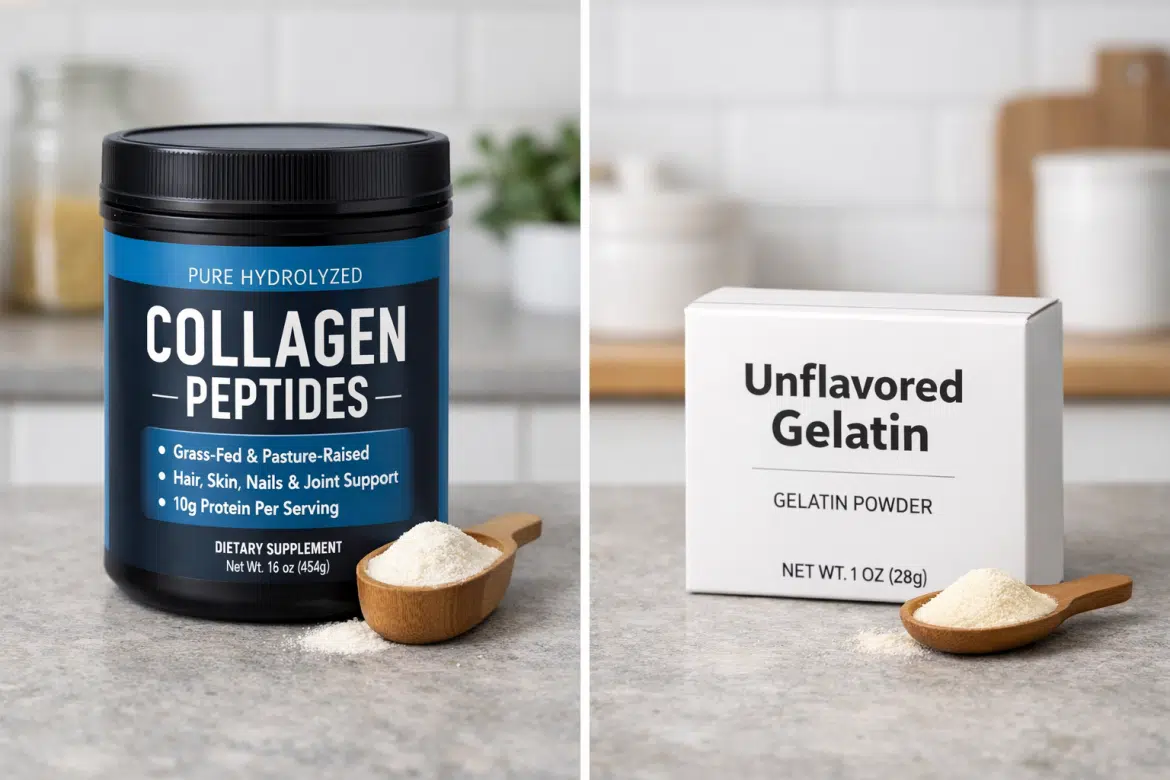
Key Points 🔍
- Main Takeaway: Culinary gelatin offers nearly identical molecular benefits to expensive collagen peptides but costs 80% less.
- Who Needs to Care: Diabetics managing skin complications, budget-conscious patients, and anyone navigating the 2026 supplement inflation.
- Why It Matters in 2026: With rising costs of GLP-1 medications and food, optimizing your supplement budget without sacrificing health outcomes is critical.
Table of Contents
Let’s be real: living with diabetes in 2026 is expensive. Between the co-pays, the CGM sensors, and perhaps the high cost of newer therapies like GLP-1 agonists, your wallet is already working overtime. So, when the wellness industry tells you that you must buy a $60 tub of “medical-grade” hydrolyzed peptides to save your skin, it feels like just another tax on your health.
But here is the thing: the science suggests you might be paying a 300% markup for a product that is biochemically almost identical to something you can find in the baking aisle for a few dollars.
This isn’t about cutting corners; it’s about understanding the biology. When we analyze Gelatin vs. Collagen for diabetic skin health, the winner isn’t necessarily the one with the sleekest packaging. It’s the one that delivers the right amino acids safely and effectively.
The “Premium” Trap: Understanding the Molecular Spaghetti
To understand why you might be overpaying, we have to look at the molecule itself.
Native collagen (like what you’d find in a cow’s hide) is a triple helix—imagine three ropes twisted tightly together. It’s tough. If you chewed on raw hide, your body couldn’t break it down.
When you cook that collagen (think bone broth), heat unravels those ropes. The strands separate into random coils. This is gelatin. It has the exact same amino acid profile as the original collagen; it’s just relaxed.
Collagen peptides (hydrolysate) take it one step further. Manufacturers use enzymes to chop those long gelatin strands into tiny confetti-sized pieces.
Here is the 2026 reality check: The industry claims these tiny pieces are “better” because they absorb faster. And technically, they do—peptides hit your bloodstream in about 60 minutes. Gelatin takes closer to 2–3 hours.
But does that speed matter for your skin?
Unless you are an Olympic sprinter needing instant recovery, probably not. For a diabetic patient looking for overnight tissue repair, the “slow drip” of amino acids from gelatin might actually be better. The data shows that whether you take the fast lane (peptides) or the scenic route (gelatin), the destination—total amino acid absorption—is roughly the same (approx. 85-90%).
The “Glycation Gap”: Why Your Skin Actually Needs This
If you are navigating life with high blood sugar, your skin is fighting a different battle than the average person. We call this the “Glycation Gap.” According to recent data [External Link: CDC National Diabetes Statistics Report], over 38 million Americans are managing this metabolic balancing act, and skin complications are often the first visible sign.
Excess sugar in the blood bonds to the proteins in your skin, creating sticky, rigid structures called Advanced Glycation End-products (AGEs). This is why diabetic skin often feels stiffer, dryer, and heals slower.
This helps explain why the Gelatin vs. Collagen debate is so critical for you. Both substances are packed with glycine, a metabolic powerhouse amino acid.
Glycine: The Secret Weapon
- Insulin Sensitivity: Studies suggest glycine deficiencies are linked to insulin resistance. Supplementing can help improve glucose handling.
- AGE Defense: Glycine helps detoxify methylglyoxal, a nasty molecule that speeds up skin aging and damage.
- Glutathione Production: It’s a precursor to your body’s master antioxidant, helping you fight the oxidative stress that comes with diabetes.
The Economic Reality: Stop Paying the “Collagen Tax”
Let’s look at the numbers. In the current economic climate, efficiency is king.
| Feature | Collagen Peptides (The Hype) | Beef Gelatin (The Hero) |
| Cost per Month | ~$50 – $60 | ~$15 – $20 |
| Processing | Enzymatically Chopped | Thermally Unraveled |
| Absorption | Rapid (1 hour) | Moderate (2-3 hours) |
| Amino Acid Profile | Identical | Identical |
When comparing Gelatin vs. Collagen, switching to gelatin could save you over $400 a year. That’s enough to cover several months of CGM sensors or co-pays.
For a deeper dive on how to balance your macronutrients while managing costs, check out our comprehensive guide to high-protein, low-carb diabetic nutrition.
Safety First: The Kidney & Stone Warning ⚠️
Before you rush to the store, we need to talk about safety. Gelatin and collagen are high in hydroxyproline, which your liver converts into oxalate.
If you have a history of kidney stones, this matters. High doses can increase urinary oxalates, potentially leading to stones.
The Renal Rule:
If you have Chronic Kidney Disease (CKD), specifically Stage 3 or lower (eGFR < 60), you must talk to your renal dietitian. As noted by the [External Link: NIDDK Kidney Disease Diet Recommendations], monitoring protein intake is essential to prevent additional load on the kidneys. Even though gelatin is a “superfood” for skin, your kidneys might see it as extra work.
The “Sugar-Free” Trap:
Avoid the commercial sugar-free Jell-O boxes. They are often loaded with Maltodextrin.
- The problem: Maltodextrin has a higher Glycemic Index than table sugar.
- The result: You eat it for skin health, but it spikes your blood sugar, causing more glycation. It’s a vicious cycle you want to avoid.
How to Use Gelatin (Without the Clumps)
The main reason people pay for peptides is convenience. They dissolve in cold water. Gelatin, if you just dump it in, turns into a rubbery puck.
But you can hack this with the “Bloom” technique:
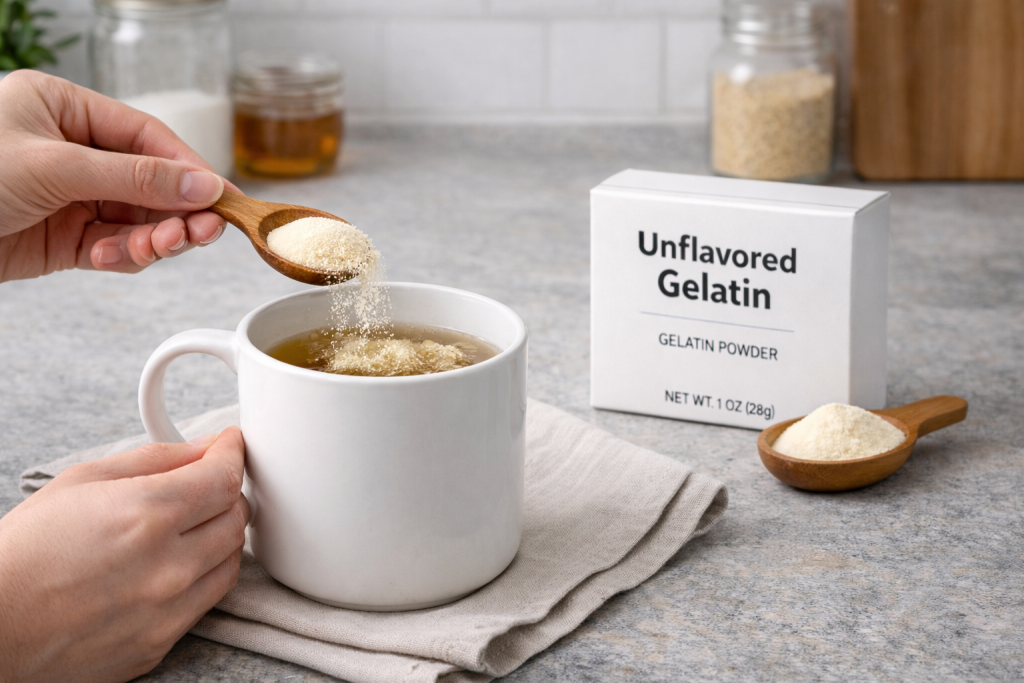
- Bloom: Put 1 tbsp of cold water in a mug. Sprinkle 1 tbsp of gelatin powder over it. Let it sit for 3 minutes until it looks like applesauce.
- Dissolve: Pour your hot coffee, tea, or bone broth over it.
- Enjoy: It dissolves instantly in the heat.
The Night-Time Advantage
Here is a pro-tip: Take your gelatin at night. Glycine decreases core body temperature and acts as an inhibitory neurotransmitter. It helps you sleep. Better sleep means better cortisol control, which means better blood sugar numbers in the morning.
The Verdict
At the end of the day, the Gelatin vs. Collagen choice comes down to marketing vs. physiology. If you have money to burn and hate stirring, buy the peptides. But if you want the same therapeutic impact—stronger skin, better wound healing potential, and glycine support—for a fraction of the price, unflavored gelatin is the clear winner.
Don’t let the shiny labels fool you. Your skin can’t tell the difference, but your bank account certainly will.
FAQ: Common Questions on Gelatin & Diabetes
1. Can gelatin really help heal diabetic foot ulcers?
While it’s not a magic cure, the data is promising. Gelatin provides the specific building blocks (arginine, glycine, and proline) your body needs to build granulation tissue. Think of it as delivering a truckload of lumber to a construction site; it ensures your body has the raw materials to repair the wound bed, provided your blood sugar is managed.
2. Is there a difference between marine and bovine collagen for diabetics?
Marketing will tell you marine is “superior” due to smaller particle size, but clinical trials generally show no significant difference in skin elasticity outcomes between the two. Unless you are pescatarian or have religious restrictions regarding beef, bovine gelatin offers the same amino acid profile at a much lower cost.
3. Will taking gelatin spike my blood sugar?
Pure, unflavored gelatin contains zero carbohydrates and will not spike blood glucose. However, it is insulinogenic, meaning it can stimulate a small insulin release (like any protein). This is generally beneficial for blood sugar control, unlike the maltodextrin found in “sugar-free” dessert mixes, which definitely can spike your sugar. (wegmans)
4. How much gelatin should I take daily for skin benefits?
Current research suggests a “therapeutic window” of about 10 grams daily (roughly one tablespoon). This appears sufficient to boost skin hydration and elasticity. Mega-dosing (20g+) isn’t necessary for skin health and increases the risk of bloating or kidney stress.
5. I have Stage 3 Kidney Disease. Is gelatin safe for me?
You should proceed with caution. Gelatin counts toward your daily protein intake. If your nephrologist has you on a protein-restricted diet (e.g., 0.6g/kg), a tablespoon of gelatin takes up a significant chunk of your daily allowance. Always consult your renal dietitian before adding concentrated protein supplements.
