
🔍 Quick Summary (For Fast Readers)
If you have PCOS, your body isn’t “normal” when it comes to processing fuel. Traditional “eat less, move more” advice often backfires because it ignores insulin resistance, stalls your metabolism, and spikes your cortisol. To actually see results, you need to stop chasing calorie deficits and start focusing on metabolic health through protein-rich meals, resistance training, and better sleep. Success in 2026 is about fixing the hormones first; the fat loss follows.
Real Talk: Why Your PCOS Weight Loss Is Stuck (And It’s Not Your Fault)
Let’s have a heart-to-heart. If you’ve been grinding at the gym and living on salads but the scale hasn’t budged an inch, you aren’t “lazy” and you certainly aren’t “cheating.” You’re likely being gaslit by outdated medical advice that treats every body the same.
For those of us navigating the world with PCOS, the standard “calories in, calories out” (CICO) model is, quite frankly, a total bust. In 2026, we finally have the receipts to prove why.
The Metabolic Glitch: Why “Eat Less” Is Failing You
Most weight loss gurus assume you have a metabolically “clean slate.” But PCOS is fundamentally a state of chronic insulin resistance. This means your body is essentially “metabolically inflexible.”
When you slash your calories to the bone or do hours of soul-crushing cardio, you aren’t just burning fat. You’re actually triggering something called adaptive thermogenesis. Your body thinks it’s starving, spikes your cortisol (the stress hormone), and holds onto every ounce of fat for dear life. Research indexed on PubMed confirms that women with PCOS struggle to access stored fat for energy—meaning you’re exhausted, hungry, and still not losing weight. It’s a vibe nobody asked for.
Insulin: The Ultimate Gatekeeper
Think of insulin as the “lock” on your fat cells. In a healthy body, insulin opens the door for energy. In a PCOS body, that lock is jammed. Between 2020 and 2026, clinical trials have shown that high insulin levels basically put your body into “permanent storage mode.”
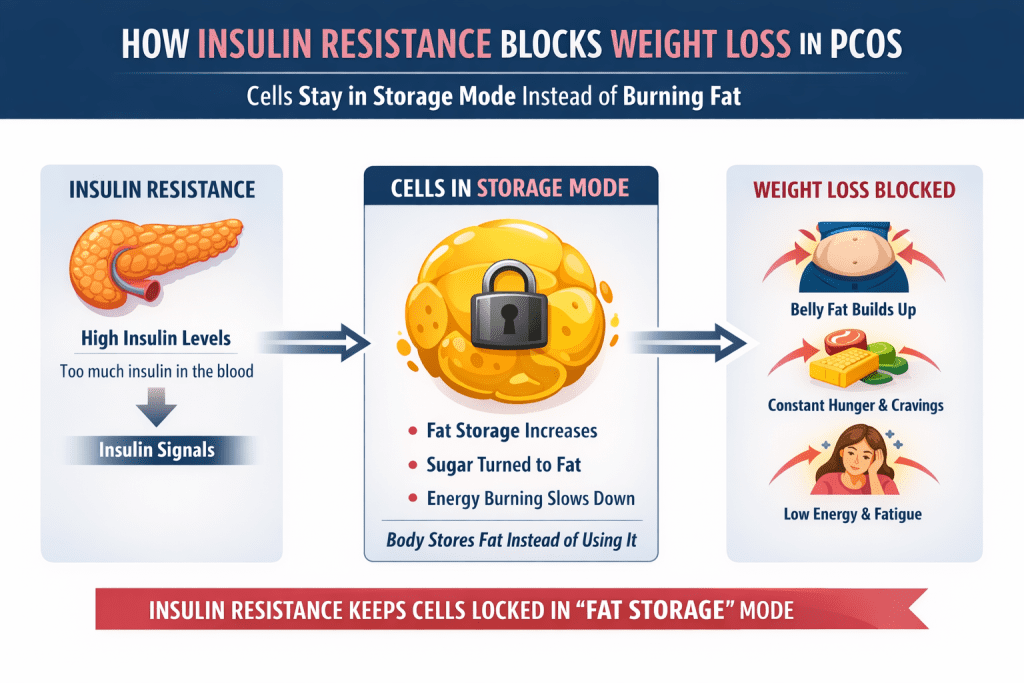
Even if you’re eating “healthy” carbs, if your insulin is high, your body will prioritize making new fat cells (especially around the belly) rather than burning what you already have. This is why we see so many women on Reddit and other forums venting that their “belly fat just won’t move.” It’s not a lack of discipline; it’s a hormonal stalemate.
🛑 ARE YOU MAKING THESE MISTAKES?
If you’ve been trying everything and still feel stuck, you might be falling for the biggest metabolic traps of the year. Check this out: Still Insulin Resistant? The Biggest Mistakes Blocking Reversal in 2026
Why the “Trendy” Diets Might Be Making Things Worse
We’ve all seen the influencers pushing 24-hour fasts or extreme Keto. While these might work for your cousin who doesn’t have a hormonal imbalance, they can be a disaster for hormone balance in PCOS.
Aggressive fasting can skyrocket your sympathetic nervous system (fight or flight). This leads to:
- The “Hormonal Crash”: Dizziness, hair loss, and skipped cycles.
- The Binge-Restrict Cycle: Your brain literally overrides your willpower because it’s starving for stable glucose.
- Thyroid Slowdown: Restricting too hard tells your thyroid to “slow down the ship,” making fat loss even harder.
What Actually Moves the Needle (According to Science)
If we want to win at fat loss for women with PCOS, we have to play by different rules. Here is what the 2026 clinical evidence actually supports:
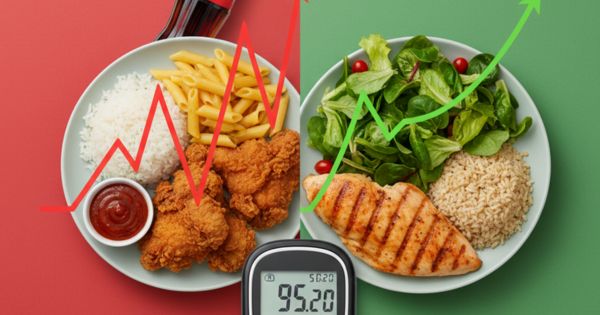
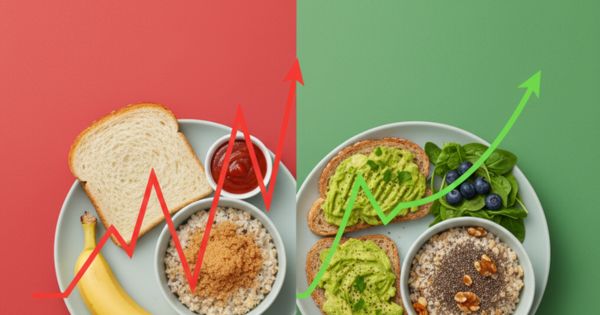
- Protein is Queen: Distributing high-quality protein across all your meals stabilizes your blood sugar and keeps you full. No more “hanger” at 3 PM.
- Lift Heavy Things: Resistance training is a cheat code. It helps your muscles soak up glucose without needing as much insulin. Plus, it builds lean mass, which burns more calories while you’re just chilling.
- Low-Glycemic Vibes: We aren’t saying “no carbs,” we’re saying “smart carbs.” Think fiber-rich and slow-burning.
- Prioritize the Pillow: Poor sleep is a one-way ticket to higher insulin resistance. The Mayo Clinic suggests that fixing your sleep hygiene is just as important as your diet.
Redefining “Success”
The biggest mistake we make is expecting the scale to drop overnight. For us, metabolic healing happens in silence before it shows up in the mirror. You’ll likely notice your energy coming back, your periods becoming regular, and your cravings disappearing weeks before the weight actually starts to move.
Don’t quit five minutes before the miracle happens. When you fix your metabolic health, the weight loss stops being a fight and starts being a natural byproduct of a healthy system.
📊 Frequently Asked Questions
1. Why do I gain weight even when I eat like a bird? Because PCOS creates “metabolic slow-mo.” Your high insulin levels keep you in storage mode, and your body adapts to low calories by burning fewer of them.
2. Can I reverse insulin resistance without meds? For many, yes! Diet, resistance training, and sleep are the foundations. However, some people find great success combining these with supplements or prescriptions. Check with Harvard Health for the latest on metabolic interventions.
3. Is cardio bad for PCOS? Not “bad,” but excessive, high-intensity cardio can spike cortisol. We usually recommend walking and strength training as the “Goldilocks” zone for PCOS.
4. How long does it take to see PCOS weight loss results? Real talk: give it 3 to 6 months. Your hormones need time to recalibrate before your fat cells get the memo.
5. Why is my belly fat so stubborn? Abdominal fat in PCOS is highly sensitive to insulin and androgens (male hormones). Addressing the insulin “lock” is the only way to effectively target that area.